Among all the genres of vintage poster art, the Art Deco ski posters of the 1930s occupy a special place. They are not merely advertising — they are a distillation of an era: the optimism of the interwar years, the democratisation of winter sport, the romance of the mountain railway, and the graphic confidence of a generation of artists who believed commercial art could be high art. Here is everything you need to know about them.
Art Deco as a style emerged from the 1925 Paris Exposition Internationale des Arts Décoratifs et Industriels Modernes, and its influence spread rapidly through every area of design — architecture, fashion, furniture, and poster art. In ski posters, the Art Deco signature is unmistakable: strong diagonal compositions that convey speed and movement; a limited palette of three to five bold colours; geometric simplification of natural forms like mountains and snow; stylised human figures that suggest motion through abstraction rather than photographic detail; and bold, often integrated lettering that is part of the composition rather than a caption.
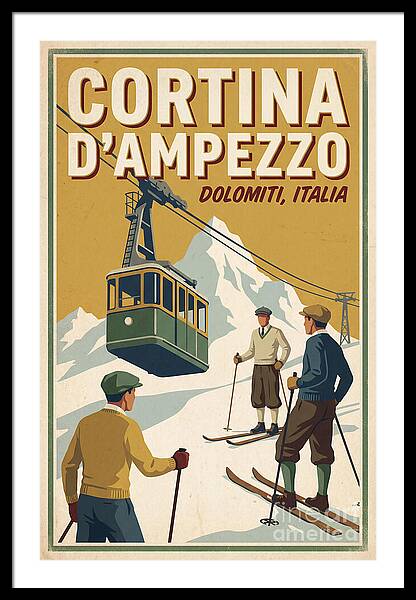
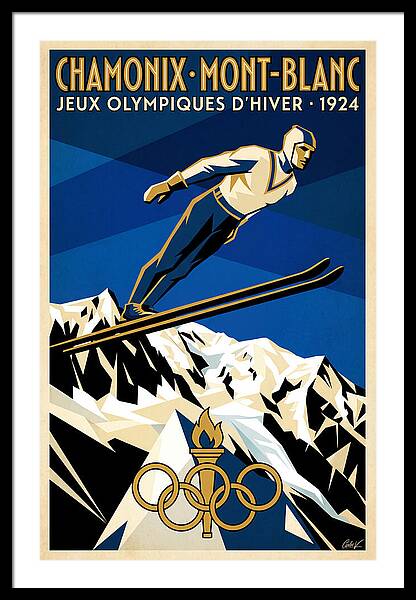
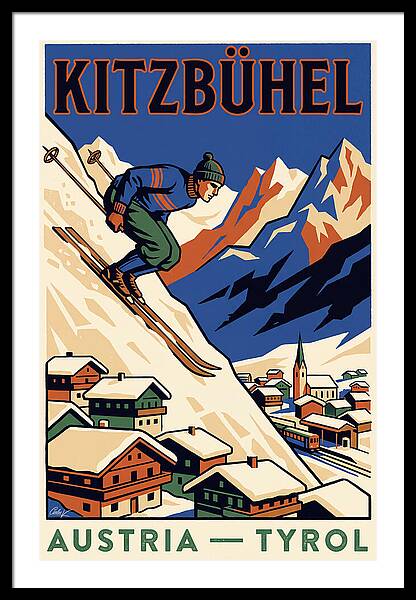
The most celebrated Art Deco ski posters depicted the resorts that were defining alpine travel in the 1930s. Chamonix-Mont Blanc — already famous from the 1924 Winter Olympics — appeared in dozens of posters commissioned by the PLM Railway and later the SNCF. Kitzbühel in Austria, home of the Hahnenkamm downhill race since 1931, produced posters of steep, dramatic compositions. Cortina d'Ampezzo in the Italian Dolomites, which would host the 1956 Winter Olympics, accumulated a rich poster tradition throughout the 1930s. St. Anton am Arlberg — where Hannes Schneider developed the modern technique of alpine skiing — was depicted as both a sporting destination and a place of wild mountain beauty.
Original 1930s ski posters — produced by lithography on heavy paper — are rare and expensive, typically selling at auction for hundreds or thousands of dollars depending on the artist and condition. What is more accessible, and arguably more appropriate for everyday display, are high-quality modern prints inspired by the Art Deco aesthetic. These can be printed at exact sizes for your wall, in archival quality that will last as long as an original, and at a fraction of the cost. The key is to choose prints that genuinely understand the Art Deco visual language — bold geometry, limited palette, dynamic composition — rather than simply adding vintage-style texture to a modern illustration.
Art Deco prints reward bold display. They were designed to be seen from a distance, to stop a railway passenger in their tracks, to be read across a busy concourse. Give them space — a large print on an uncluttered wall is far more effective than a small print surrounded by other objects. Black frames are the natural choice, echoing the bold outlines of the style itself. A single large Art Deco print — 24×36" or larger — above a fireplace or at the end of a hallway makes the strongest possible statement.
If you are building a collection around the Art Deco era, focus on resorts with a strong 1930s heritage: Kitzbühel and St. Anton in Austria; Chamonix, Megève, and Val d'Isère in France; Cortina d'Ampezzo, Madonna di Campiglio, and the Italian Dolomites generally; Mürren, Pontresina, and Arosa in Switzerland. Each of these places has a visual identity rooted in the 1930s that continues to define how they are seen today.
Ready to find the perfect print for your mountain home?
Shop Art Deco Ski Prints →